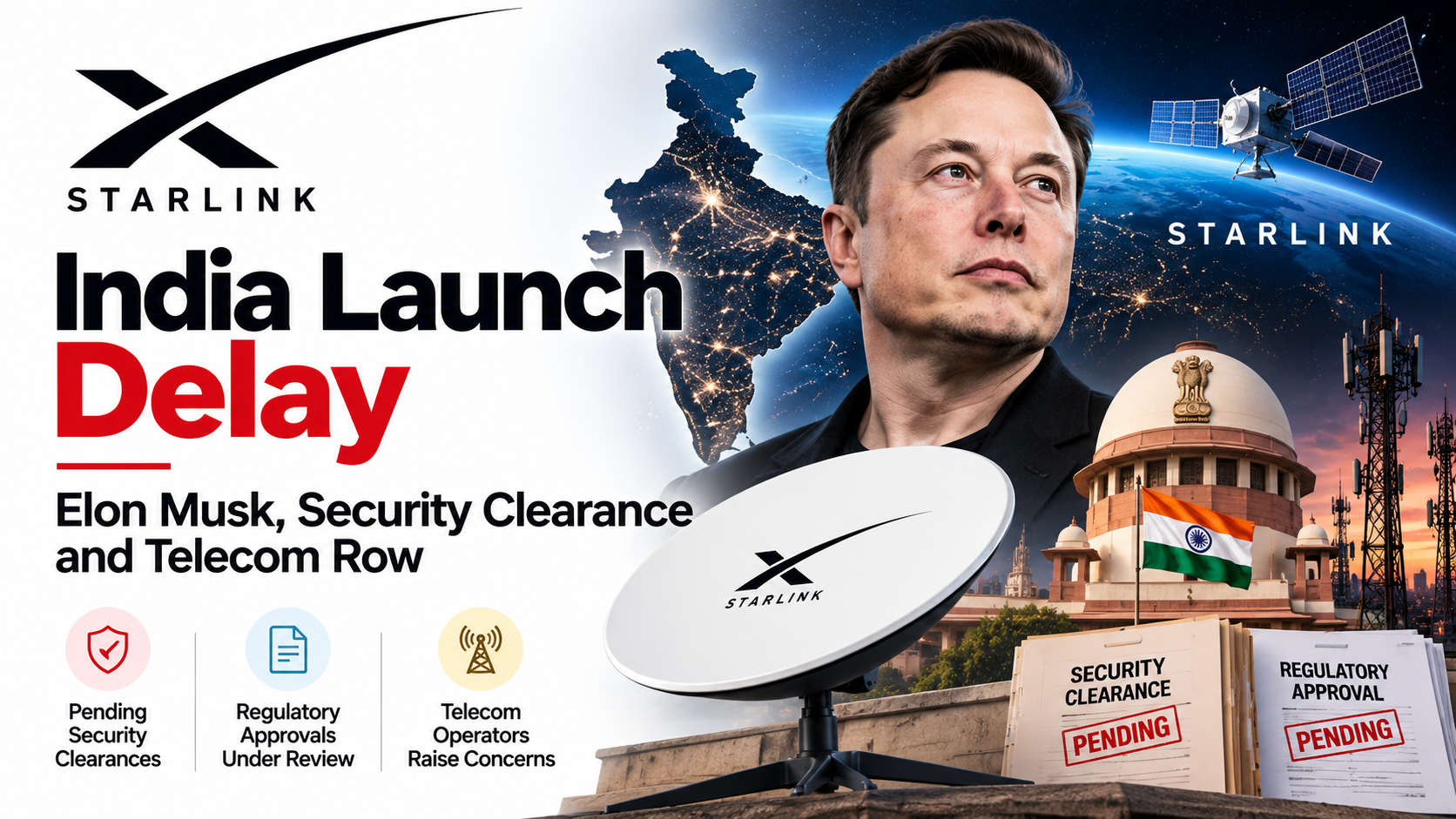
NEW DELHI, October 10, 2026: Elon Musk’s ambitious plan to bring Starlink satellite internet to India has run into a fresh confrontation over regulatory delays, national security and competition in one of the world’s largest connectivity markets. The SpaceX-owned service has secured important approvals, prepared its India operations and said it is ready to serve customers, yet commercial services remain on hold as outstanding clearances continue to delay its entry.
The dispute escalated this week after Musk publicly questioned why Starlink had not been allowed to begin commercial operations despite years of work to meet Indian requirements. He also challenged the influence of Reliance Industries chairman Mukesh Ambani, suggesting that powerful business interests could be preventing a potential competitor from entering the market. His comments have brought renewed attention to the relationship between regulatory oversight and competition in India’s rapidly evolving telecommunications sector.
However, allegations of deliberate obstruction remain unproven. The government has rejected claims that Starlink is being treated unfairly, maintaining that satellite communication operators must individually satisfy the security requirements and regulatory conditions applicable to their services. Communications Minister Jyotiraditya Scindia has emphasised that three companies have received satellite communication licences and that no operator can begin commercial operations without completing the necessary compliance process.
The distinction is important. Starlink’s delay does not mean the company has been denied every major approval. It received a licence from the Department of Telecommunications in June 2025, followed by authorisation from India’s space regulator, IN-SPACe, in July 2025. Those approvals marked significant progress towards its planned entry. However, licensing and space-sector authorisation do not, by themselves, constitute final permission to start selling satellite internet services to customers across the country.
Security clearance remains a central hurdle. Satellite internet operates differently from conventional broadband delivered through fibre-optic cables or mobile towers. A customer terminal communicates with satellites in orbit, while ground infrastructure connects the satellite network to the wider internet. This architecture can extend connectivity to locations where conventional networks are difficult or expensive to deploy, but it also raises questions about lawful interception, network monitoring, terminal identification and the handling of Indian users’ data.
For the Indian government, these are operational requirements rather than optional safeguards. Authorities want satellite operators to comply with domestic security rules, maintain the required infrastructure within India and ensure that communications can be monitored in accordance with the law. Gateway approvals, spectrum assignment and other regulatory conditions are also relevant to the launch process. Starlink must complete the remaining requirements before it can offer its service commercially.
SpaceX has argued that it has adapted its operations to India's regulatory environment. A company executive said at the India Mobile Congress that Starlink’s Indian operations had been designed around local security and regulatory requirements, including keeping Indian user data within the country. The company’s position is that it has invested considerable time and effort in preparing for launch and is waiting for the outstanding approvals to be completed.
The government, meanwhile, has pointed to the broader regulatory position. Other licensed satellite communication operators, including Eutelsat OneWeb and Jio Satellite Communications, are also subject to security and operational requirements. This weakens any assumption that the delay affecting Starlink, by itself, proves that authorities are deliberately favouring an established telecom company. At the same time, the dispute raises a legitimate policy question: how can India enforce stringent security standards without allowing lengthy approval processes to create uncertainty for companies seeking to enter the market?
The stakes extend beyond the public disagreement between Musk and Indian business leaders. India has a vast internet user base, but reliable connectivity remains uneven in remote villages, mountainous regions, border areas and locations where fibre deployment is commercially challenging. Satellite broadband could offer an additional way to connect households, businesses and public services in such areas. Its practical value, however, will depend on availability, pricing, equipment costs and the quality of service customers receive.
Starlink would also enter a market where established telecom operators already offer comparatively affordable mobile data and are expanding fixed-wireless and fibre broadband services. Satellite internet is not automatically a cheaper or faster replacement for these connections. Its strongest potential advantage is reaching users who lack dependable terrestrial alternatives. The extent to which it can compete more broadly will depend on its eventual Indian pricing, service terms and regulatory permissions.
For consumers, the immediate problem is uncertainty. Without a confirmed commercial launch date, prospective customers cannot reliably plan purchases around an official service rollout. Any advertised equipment prices, subscription offers or availability claims should be treated cautiously unless they are confirmed through authorised channels.
The next decisive developments are likely to be the completion of security assessments, the remaining regulatory permissions and the formal assignment of spectrum needed for commercial service. Until those steps are resolved, neither Musk’s public criticism nor the company’s launch preparations can substitute for official clearance.
Starlink’s India challenge is therefore about more than a clash between two powerful business figures. It is a test of how the country balances national security, transparent regulation and competition in satellite communications. A clear and predictable approval process would help both operators and consumers understand what remains to be done. Whether the current confrontation accelerates that process or prolongs the uncertainty remains to be seen.